Mining in South Africa is primarily governed by the Mineral and Petroleum Resources Development Act 28 of 2002 (MPRDA), which vests custodianship of all mineral and petroleum resources in the State, declaring these resources the “common heritage of all the people of South Africa”.
As the ‘competent authority’, the Department of Mineral and Petroleum Resources (DMPR) administers this regime. No person may prospect or mine without a right granted by the DMPR. A prospecting right permits exploration through geological surveys, trenching, drilling and bulk sampling for up to five years and may be renewed. A mining right authorises commercial extraction for up to 30 years, also subject to renewal.
In 2014, Parliament introduced the One Environmental System (OES) to align mining authorisations and activities ancillary to mining under the MPRDA with environmental authorisation processes under The National Environmental Management Act 107 of 1998 (NEMA) – streamlining what was a fragmented and onerous process of environmental and mining authorisation into a single, fast-track decision-making process.
However, the reform did more than streamline paperwork. It shifted responsibility for environmental approvals in the mining sector to the same department tasked with promoting mining, the DMPR, a change that has drawn sustained criticism from scholars and civil society.
Section 24 of the Constitution of the Republic of South Africa, 1996, guarantees everyone the right to an environment that is not harmful to their health or wellbeing. The Constitution requires the State to protect the environment for present and future generations through reasonable legislative and other measures to prevent pollution and ecological degradation, to promote conservation, and secure ecologically sustainable development, while promoting justifiable economic and social development.

NEMA gives effect to this right and establishes binding environmental management principles on all organs of state, including sustainable development, the precautionary approach principle, transparency, intergenerational equity and meaningful public participation.
Under NEMA, certain listed activities that impact the environment may not commence without prior environmental authorisation, which includes a Public Participation Process (PPP). Impacts must be identified, assessed and reported before decisions are taken. Mining is therefore regulated by the DMPR at the intersection of the MPRDA and NEMA.
However, although robust on paper, the PPP contains flaws that undermine its effectiveness.
The PPP is required by Environmental Impact Assessment (EIA) regulations under NEMA for prospecting and mining applications. Submissions should undergo public scrutiny and feedback before approval. Anyone can register and take part as an Interested and Affected Party (I&AP) to lodge comments and objections.
Most applications are for prospecting rights rather than mining rights. Prospecting applications can rely on pre-existing geological data in the form of desktop studies. These applications can lack on-the-ground scientific or technical verification that is required to properly assess the potential ecological damage to the proposed location.
Documents shared with the public are often poorly researched, incomplete, voluminous, technically flawed, and not translated into regional languages. Insufficient notification to communities, landowners and other Interested and Affected Parties (I&APs) leaves little time for people to comment or object.
All these are important deficiencies in the PPP, which should be inclusive. Under GNR 1147 (the Financial Provisioning Regulations of 2015) rehabilitation and mine closure plans must be drawn up by suitably qualified ‘specialists’ or ‘registered professionals’.
‘Specialist’ and ‘registered professional’ are interpreted to mean professional scientist or professional engineer. However, often rehabilitation and mine closure plans are drawn up by Environmental Assessment Practitioners (EAPs) without the necessary scientific, technical, engineering or financial expertise.
EAPs commonly underestimate the area to be disturbed by exploration and mining activities. This can lead to an underestimation of the costs of rehabilitation. Consequently, financial guarantees lodged with the government fall short of actual rehabilitation and decommissioning costs.
Moreover, the Mining Work Programme and Rehabilitation Plan are key documents in which the work programme, rehabilitation and projected costs are discussed in detail. Applicants often seem reluctant to make these two documents public. Without these documents it is impossible to undertake a meaningful evaluation of the environmental risks associated with the proposed mining activities.
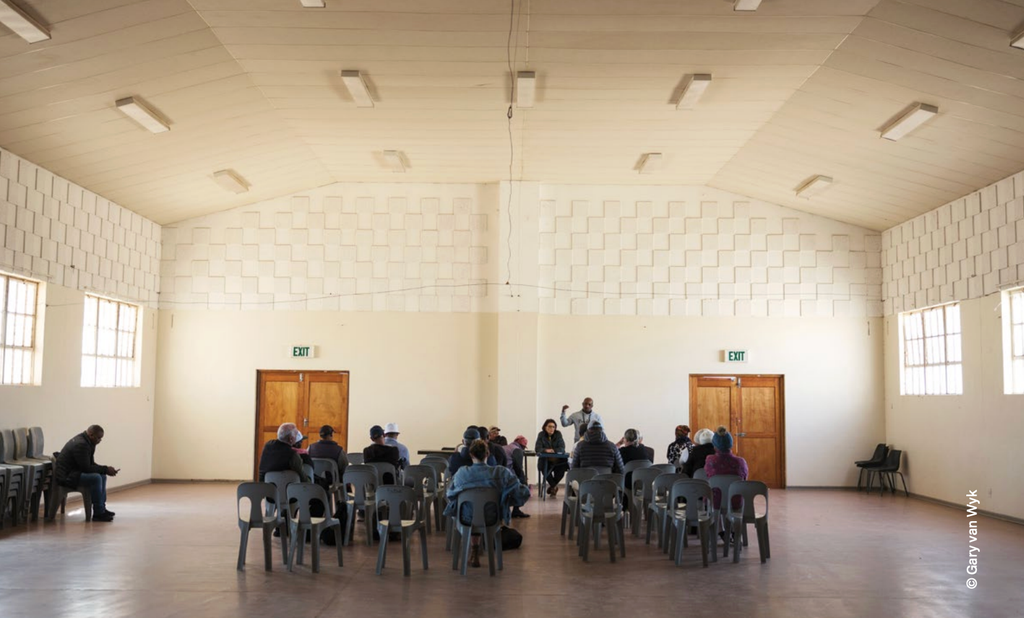
While EIA regulations are clear that special attention must be given to ensure disadvantaged people can participate meaningfully, few public processes meet this requirement. The time and venue of public meetings are often poorly advertised, held in hard-to-access locations, methods of engagement are not appropriate for the audience, and presenters use technical language, while some give inadequate time to address community concerns.
Furthermore, meetings have been cancelled without adequate notice, or are held online, which excludes community members without access to the internet. Facilitators often arrive unprepared to address community concerns. In some cases, stakeholder enquiries are ignored, applications postponed without explanation, and correspondence from EAPs, when it occurs, is unsigned or anonymous.
This is compounded by undisclosed consultant changes, document reissues without notification, and unauthorised property access, all of which erode public trust and violate principles of transparent, inclusive consultation.
Mining companies appoint and pay large fees to EAPs and others managing the PPP, expecting an approval in return, which leads to a system that arguably favours mining over public and environmental wellbeing. Approvals by the DMPR are made with little to no overview of cumulative impacts.
Appeals against approvals go to the DFFE. If dismissed, the only available option is judicial review, which is very costly – an often insurmountable obstacle to the only substantive remedy that can reverse decisions.
The Tipping Point
The above is an excerpt from the 2026 PTWC Special Report: The Tipping Point
The report brought our legal, science and media teams together to create a unique 56-page expose on the state of the West Coast. Filled with history, stats and other information, the report unpacks the damage from decades of heavy mineral and diamond mining, partly as a result of weak regulatory oversight. But all is not lost. We make the case for better enforcement of legislation, a moratorium on new mining applications while an assessment of cumulative impacts is conducted, with more investment in alternative economic solutions, such as nature-based industries, including ecotourism.
Read the full Special Report here:
Make your voice heard
Sign up to the Ripl public participation platform here: