When people think of estuaries, they often picture mudflats and sandbanks, with a waterbody connected to the sea. In reality, estuaries are mosaics of habitats including submerged macrophytes (aquatic plants large enough to be visible to the naked eye), such as seagrass, salt marshes, and reed beds, each performing a different ecological role. These habitats along with the meandering channels and sandy or muddy banks shape the estuarine functional zone. Together, they are one living system.
Healthy natural environments also provide important ‘ecosystem services’ to humans, often without us even realising it. While we often refer to these as the benefits provided by estuaries, these services are the collective result of many interconnected habitats working together.
From seagrass meadows, reed beds and salt marshes to mudflats and tidal channels, each uniquely regulates natural processes (water and nutrient filtering and cycling), which supports biodiversity, strengthens climate resilience, and sustains fisheries, livelihoods and communities.
If you spend time exploring the banks of our West Coast estuaries, you’ll soon discover that they are among the country’s richest havens for biodiversity, housing some incredible endemic flora and fauna.
In ‘Please keep off the (sea)grass!’, we highlighted the endangered and endemic seagrass species, the Cape Dwarf eelgrass (Zostera capensis). However, seagrass meadows are not the only habitat type of importance, but rather the entire functioning estuarine zone, which many species rely on.
Importance of West Coast Estuaries
Estuaries are powerhouses of productivity. Along the West Coast, the Langebaan Lagoon, Berg and Olifants Estuaries support some of South Africa’s most extensive and ecologically significant salt marsh systems.
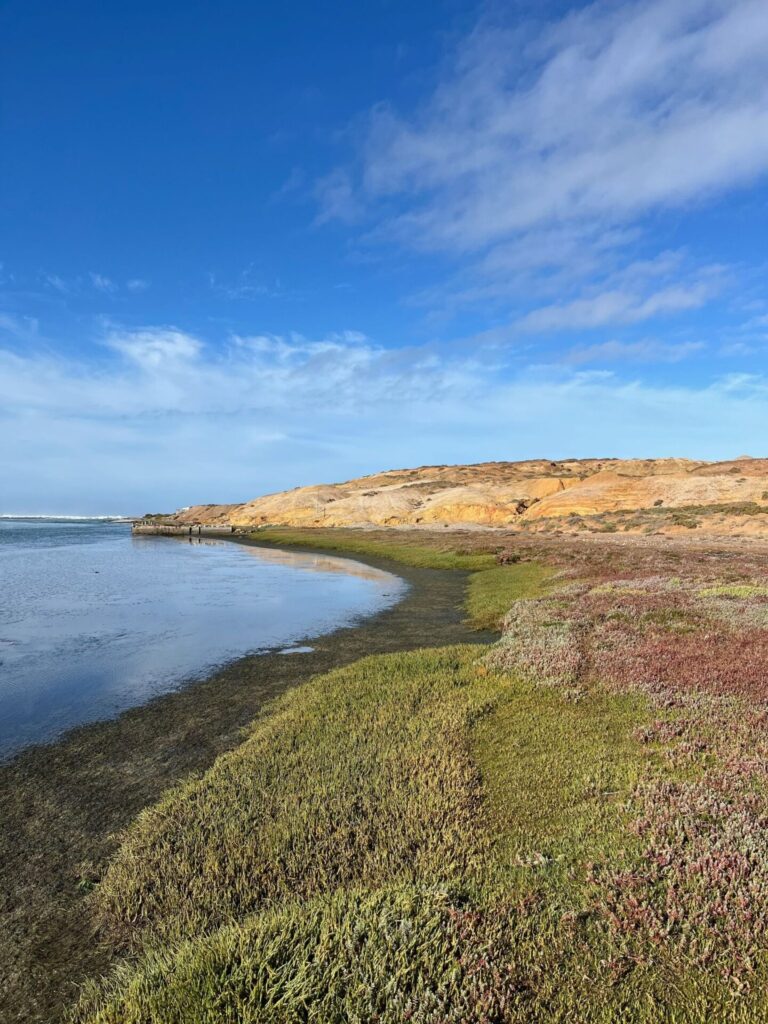
Salt marshes are coastal wetlands dominated by salt-tolerant herbs, grasses and low-growing shrubs that occur along estuarine banks. Their plant communities are naturally arranged according to elevation, tidal flooding and salinity, and can be visually observed through the different colour arrangements, creating beautiful mosaics of vegetation that range from vibrant greens to deep reds and purples.

Salt marshes provide a remarkable range of ecosystem services. They stabilise estuary banks, filter nutrients and pollutants, store significant amounts of atmospheric carbon, and reduce flooding and erosion. Their dense vegetation provides shelter for countless invertebrates, while an intricate network of roots and stems traps organic matter and nutrients that fuel productive food webs. Worms, molluscs, crustaceans and juvenile fish depend on these habitats, which creates an abundant food source for larger predators, particularly waterbirds.


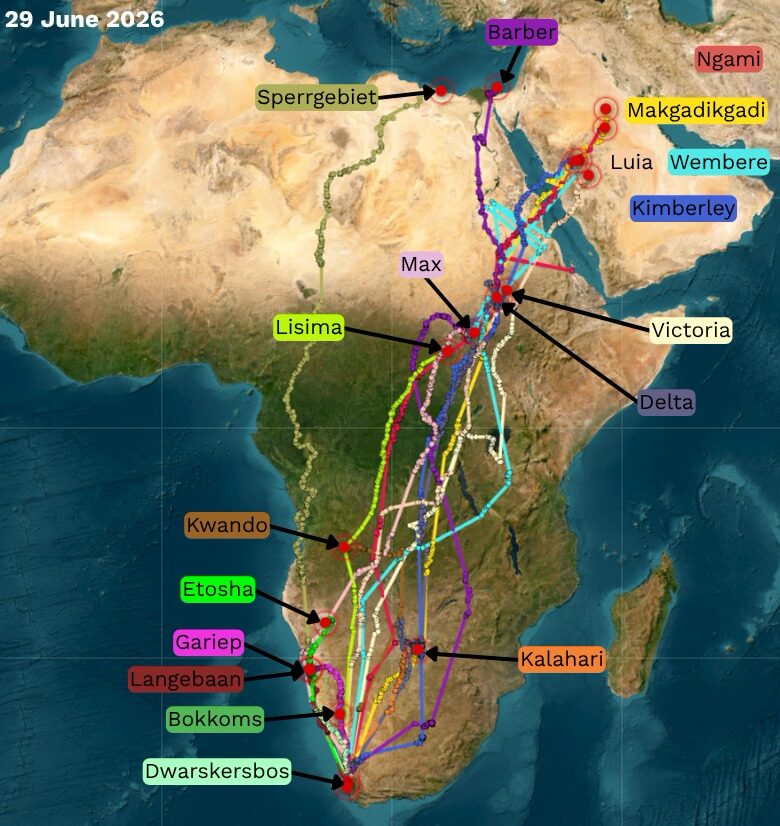
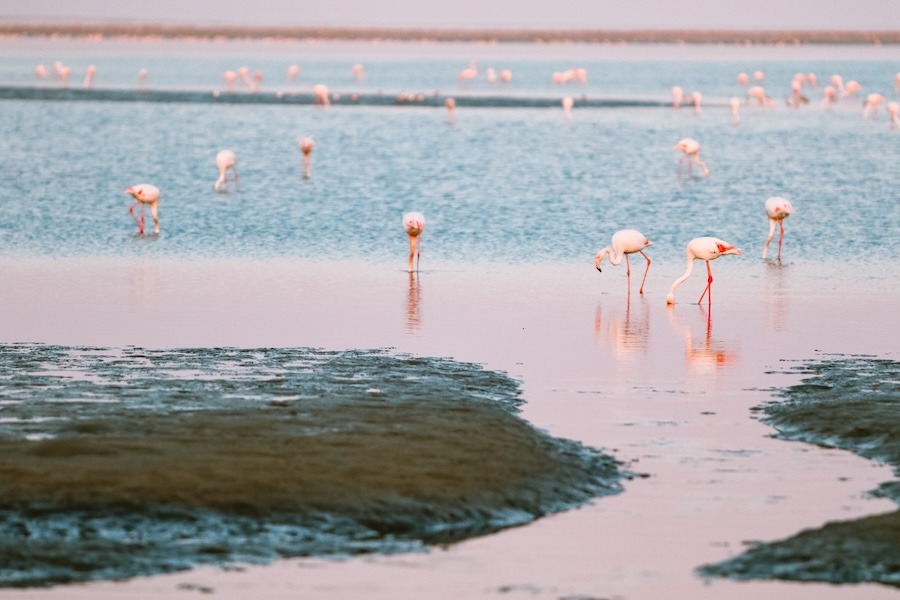
These benefits extend far beyond the boundaries of the estuary. Estuaries are internationally connected, as migratory shorebirds (considered some of the most threatened in the world) rely on a network of wetlands across continents. Healthy estuaries are essential stopover sites, providing the food and refuge birds need to rest, recover and continue along their remarkable African-Eurasian flyway of more than 10,000 km.
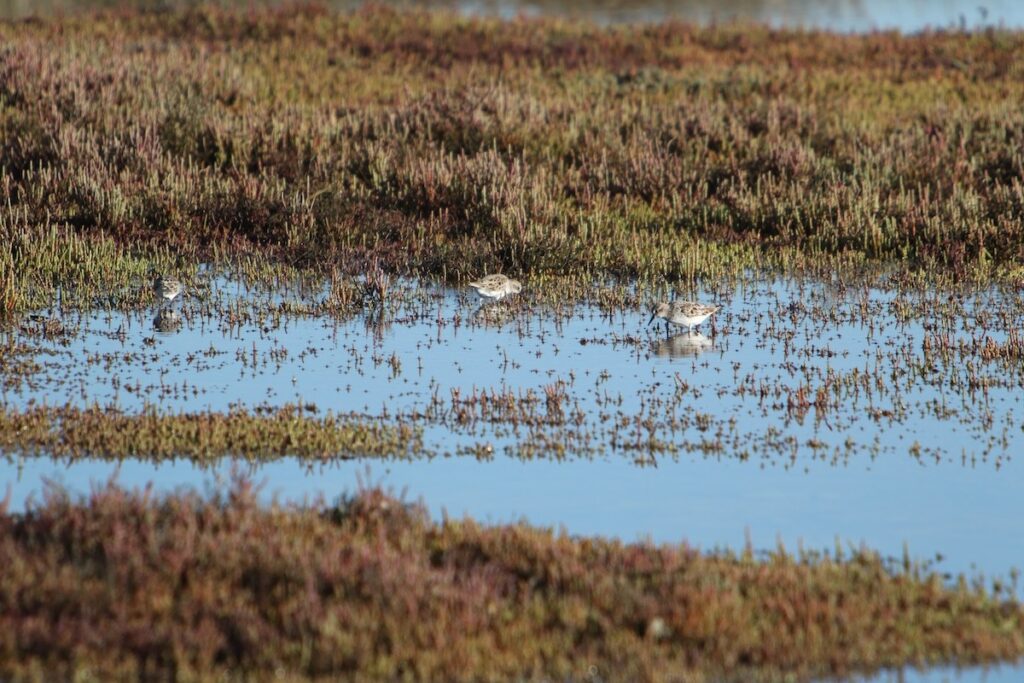
According to BirdLife South Africa, Langebaan Lagoon consistently supports over 20,000 waterbirds during summer, of which 93% are Palearctic migrants, while the Berg Estuary supports more than 8 000 migrant waders, especially Curlew Sandpiper and Little Stint.
Coordinated Waterbird Counts (CWAC), also referred to as ‘quack’ counts, is a citizen science initiative where waterbirds are counted at registered waterbodies, and the data uploaded to the CWAC website. During the first two CWAC counts at the Olifants Estuary for 2026, a total of 1,265 birds were recorded, with more than half of them (660 individuals) Curlew Sandpipers and nearly 20% Sanderlings. These numbers attest to the importance of this estuary as a critical stopover site for Palearctic migrants. Other waders, including the Grey Plover, Ruff, Wood Sandpiper, Common Greenshank, Sanderling and Bar-tailed Godwit also make use of this estuary as a stopover between travels from the Orange River to wetlands in the south or even the Wilderness-Sedgefield Lakes Complex on the east coast.

For an inside look at an exciting new frontier: tracking migratory waders from South Africa – a world first, check out Bird Life South Africa’s, Conservation Conversations – Tracking shorebirds from South Africa.
Also highly dependent on West Coast estuaries are linefish species such as white steenbras, west coast steenbras, silver kob and elf. These species utilise the sheltered estuarine habitats created by salt marshes and seagrass meadows as vital nursery grounds, where abundant food and protection from predators allow juveniles to grow before moving into the Atlantic.
Whether it is migratory birds that arrive from across the globe or juvenile fish that begin their lives along the West Coast, these examples illustrate a common theme: healthy estuaries depend on healthy habitats, and healthy habitats support entire ecosystems.
In light of the new applications by Trans Hex for diamond mining as well as other multicommodity applications in Sea Concessions 11B and 13B, with the latter situated on the doorstep of the Olifants Estuary, it is essential that the shift towards offshore mining is carefully assessed to avoid ecosystem degradation when, relative the land based environments, so little is known about those offshore habitats.
These ecosystems cannot be viewed as isolated habitats. Estuaries form part of much larger ecological networks. They support species through their life cycles. They sustain international migratory pathways, and they underpin the ecological connectivity that links rivers, estuaries, the marine environment, and ultimately the West Coast locals who depend on them.
But besides their ecological importance, they are exceptionally beautiful habitats and worth preserving – if only for that reason.
Help us keep an eye on mining activities along the West Coast by signing up to Ripl, PTWC’s digital public participation platform. Comment with your concerns on any mining and prospecting right applications to ensure your voice is heard.