1. Inadequate Science
Deeply concerning patterns have emerged from PTWC’s appeals against a range of applications, from offshore diamond mining, nickel and copper prospecting in Namaqualand, heavy mineral sands mining, and alluvial diamond prospecting in sensitive coastal surf zones.
The most disturbing is that approvals are granted with incomplete scientific input for a full picture of potential impacts. In two appeals this year against authorisations granted for nickel and copper prospecting in Namaqualand, the DMPR approved the applications despite the lack of a specialist study on risks to bird life from drone surveys.
Rather than waiting for that study, the DMPR made it a condition of approval. NEMA requires that all relevant information be in front of the decision-maker before a decision is made, and that the public has a chance to comment on it. Attaching a study as a condition after the fact satisfies neither requirement. You cannot assess what you haven’t seen, and the public cannot comment on what hasn’t been shared.
2. Lack of Fieldwork
The second pattern is what we call the “baseline problem”. Multiple assessments to determine conditions on the ground and potential impacts were based on desktop studies and outdated or inappropriate literature, rather than actual fieldwork.
A clear example is Trans Hex’s offshore diamond mining applications on the West Coast. Trans Hex has been granted Environmental Authorisations in Sea Concessions 11B and 13B, along the coast adjacent to Doringbaai, Strandfontein and Papendorp, just south of the iconic and critically important Olifants River mouth. PTWC has appealed both, and until those appeals are decided, the authorisation to mine has not been finally confirmed. The applications were assessed by the same environmental assessment practitioner, using the same specialist studies, despite legally distinct mining rights that in PTWC’s view require standalone assessments. The financial and business case for the project also raises some serious questions.
On PTWC’s understanding and its own calculations should diamond prices remain static, rather than rising at the projected 1% per annum, which the Trans Hex business case assumes, PTWC’s calculations suggest the project would record a loss of approximately R32.6 million over a ten year period. The viability of diamond mining is on the decline worldwide, and careful attention needs to be given to the financial viability of ongoing mining operations. Read more about the 13B appeal here and the Trans Hex EMPr appeal here.
At the heart of both appeals though is the baseline problem. Trans Hex has not conducted its own benthic baseline studies for the concessions and instead contends it will do so while it mines. Environmental legislation requires that a mined area be rehabilitated and restored. Without knowing what condition the seabed was in before mining began and disclosing that to the competent authority and the public, there is no baseline for restoration, and in PTWC’s view no lawful basis for granting an EA.
3. Improper Impact Assessment
A third pattern is the treatment of cumulative impacts, in other words, the compound effects of previous, current and/or surrounding mining activities relating to the application in question. Across multiple appeals this year, including the Trans Hex offshore applications and the Richwill Diamonds appeal, there has been in PTWC’s view inadequate or internally inconsistent assessment of cumulative impacts.
The Richwill appeal is a striking example. The Basic Assessment Report itself described the project area as subject to “decades of uncontrolled and environmentally irresponsible operations” then rated the cumulative impacts as of low significance. It is PTWC’s position that those two conclusions are irreconcilable. We have put this question directly to the EAP responsible for the report, N.J. van Zyl, who did not respond.
Proper cumulative impact assessment requires an accounting of what has already happened in an area, what is currently happening, and what is reasonably foreseeable. What we keep finding are impact ratings that simply don’t reflect the evidence in the reports themselves.
4. Poor Rehabilitation Planning and Funding
Inadequate rehabilitation planning is a fourth recurring problem. Financial provisioning for rehabilitation is regulated under the Financial Provisioning Regulations, GNR 1147 of 20 November 2015 under NEMA, which requires applicants to determine, secure and maintain adequate financial provision for rehabilitation, closure and post-closure management.
Across a significant number of applications reviewed this year, rehabilitation plans have been scientifically thin, financially inadequate, or both.
5. Lack of Qualifications
PTWC has also noticed, across a number of applications, that documents are compiled and signed off by people who do not appear to hold the professional qualifications the legislation requires for this work.
For example, a rehabilitation plan compiled by an unqualified person is not just a procedural issue. It undermines the very framework that is supposed to ensure mining is done responsibly. This is an issue that the PTWC will be looking into in more detail, so watch this space.
Conflict of interest in Decision making
The clear conflict of interest of the DMPR is the structural tension at the heart of how mining is regulated in South Africa. The DMPR has a mandate to promote and develop the mining industry, while it is also the authority that assesses the environmental impact and gives approvals for this industry. Our appeals suggest that this tension has real consequences.
The diagram below shows how an application moves from advertisement through public participation to a final decision, and where that decision sits: with the DMPR.
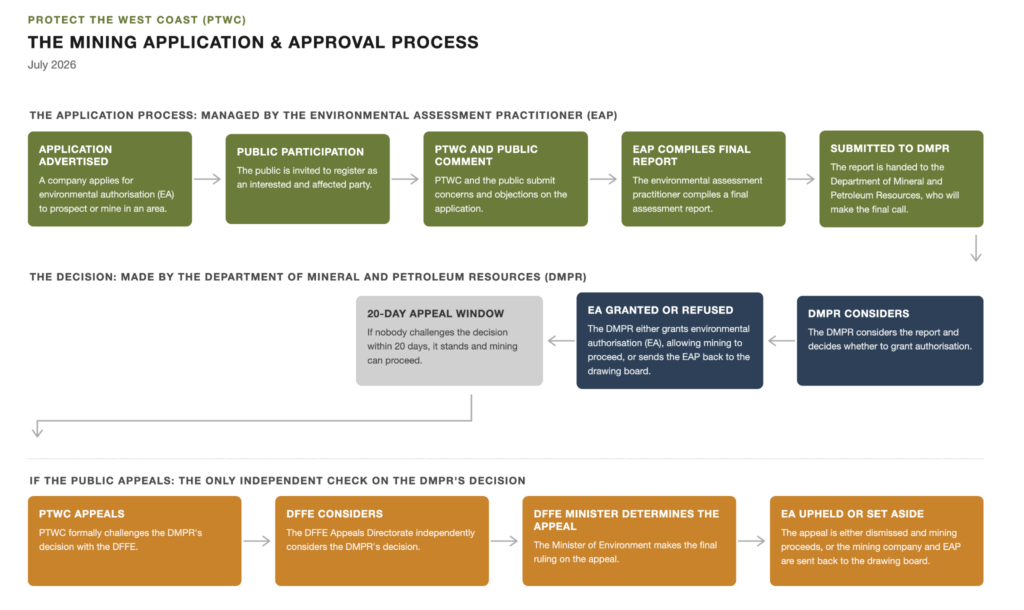
The only formal check on DMPR decisions is the appeals process, administered by the DFFE through its Appeals Directorate. If no appeal is submitted, the decision stands. That’s why the work of PTWC, and the general public who can submit appeals is so important. Without people scrutinising these decisions and lodging formal challenges, many of these authorisations would go ahead unchecked.
PTWC’s position, set out in our Special Report “The Tipping Point,” is that this conflict of interest has created a scenario where the DMPR, instead of properly applying its mind to the applications, is greenlighting applications that should not be getting out of the starting blocks. This then results in prospecting or mining going ahead where it ought not, or unnecessary appeals having to be lodged to try and stop these applications from proceeding.
Sixty applications and counting
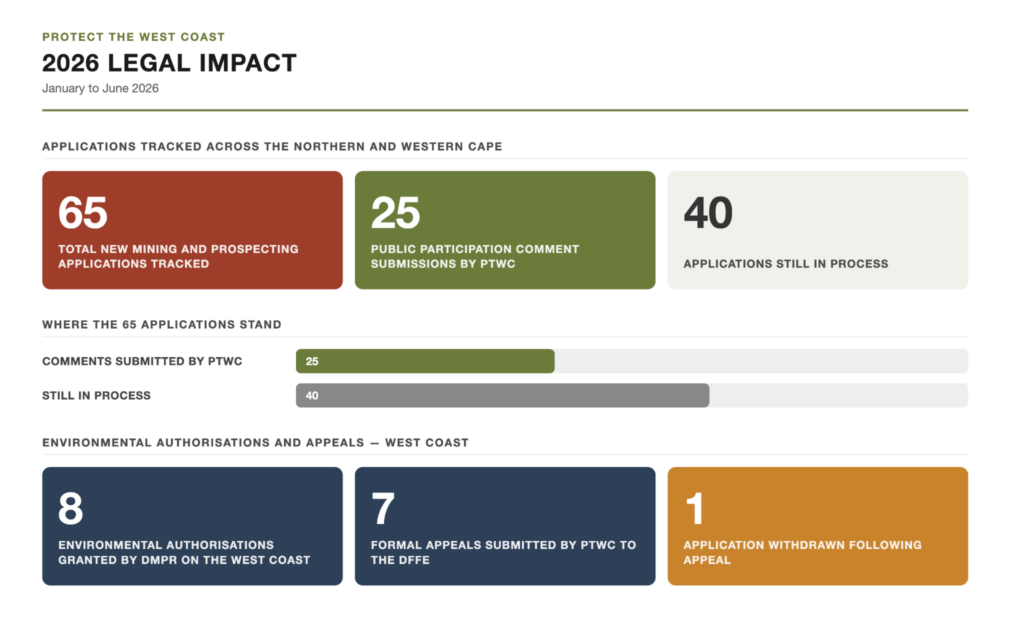
Since the beginning of 2026, we’ve tracked more than sixty new mining and prospecting applications across the Northern and Western Cape. It’s a proverbial gold rush. Each one will require public participation, specialist studies, and a decision by the DMPR.
What we’re also noticing is another trend worth flagging. Some of the companies behind these applications have no apparent or discernible track record in mining, no online presence, and in some cases appear to be linked to multiple applications. Whether their intention is to mine, or simply to acquire and then transfer any rights acquired, the pattern raises questions about who these applications are really ultimately serving.
The cogs turn slowly
The DMPR does not approve every application. Earlier this year, it refused an application by Gauteng-based company Zuculox to prospect at Britannia Bay, near St Helena Bay. Local residents formed Action St Helena Bay, which drove a campaign that generated more than 18,000 individual objections. Outright rejections are rare, but this one showed what an organised community can achieve. Read more in our St Helena Bay blog post here.
In June 2025, PTWC and six other parties lodged formal appeals against an Environmental Authorisation granted to Twiga Global Ore for prospecting near the Knersvlakte Nature Reserve in Vanrhysdorp. A year later, in June 2026, the company’s board resolved to withdraw both the Environmental Authorisation and the prospecting right application entirely. This is one less application threatening our West Coast. It is a small, but significant win, and a reminder that the public participation process and the appeals mechanism, slow as they may be, do have a real impact. Without the appeals submitted that authorisation would have proceeded, unchecked. PTWC is proud of this outcome, and proud of the broader communities, organisations and concerned citizens who continue to show up for the West Coast.
There is still much work to do, and PTWC is growing in capacity and reach to meet it. The cogs of environmental law and government administration may, sometimes, turn slowly. But they do turn, and we hope to be turning them in the right direction.
Read or download the full special report below:
Sign up to Ripl to add your voice to the protection of the west coast.