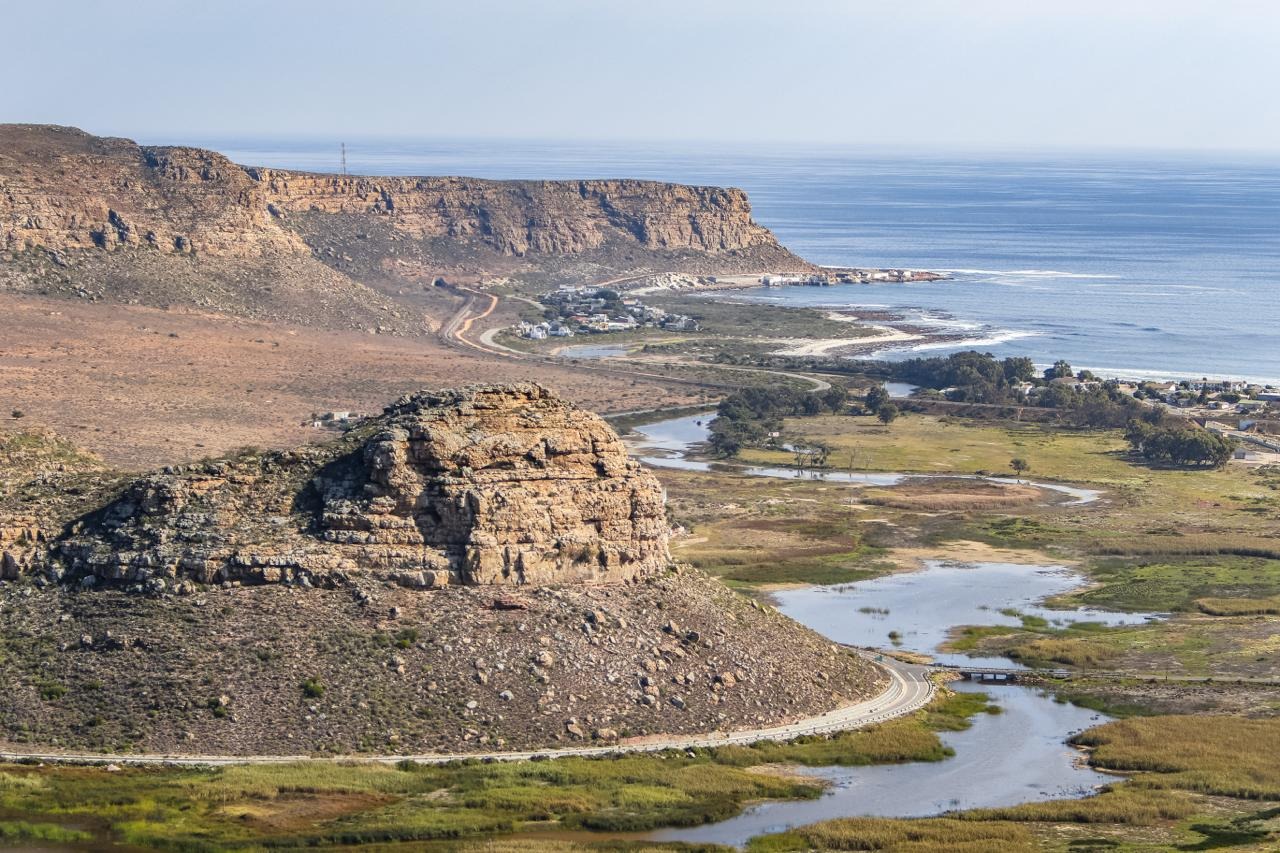
The West Coast, and the hinterland it borders, looks harsh and desolate, but a mere 30 years ago, if you were a naturalist seeking fauna and flora species endemic to specific regions, you would have unearthed a bubbling abundance in a vast, arid ecosystem.
You would have found a wonderland of curiously designed dwarf succulents from the genus Conophytum, some covered in a fine film of fur like a baby’s bottom (“baba boude” in Afrikaans). You would have found living pebbles pushed into crevices – others like “waterblasies” (water blisters), dumplings, contorted cubes or tiny bowls.
Back then, if you stopped and sat for a while in the Richtersveld and parts of the Karoo – an ancient Khoi /San word that means “dry” or “thirsty place”, you might have seen the smallest tortoise in the world amble past, ploughing a path through the plants in its bid to eat the little shrubs it likes.

Looking up, you might have seen giant tree-like plants stooped on the side of a koppie like a battalion of twisted wraiths from Lord of the Rings. Say hello to the half mens (half men) or Pachypodium namaquanum. The first word, denoting Genus, is Latin for “big feet”, due to the way the plant thickens at its base.
If you crooked your neck further and looked up, you’d see (wheeling in a stark sky seared by the summer sun), the graceful looping arc of a bird of prey – the unmistakable sky dance of a male black harrier (Circus maurus) trying to attract a female. Now the encroachment of mining and agriculture has denuded this bird to a mere 1,000 adults alive in the wild.
With extra patience, 30 years ago, in unison to the undulating breath of ancient earth, a treasure trove of other creatures and plants would slowly appear to you amongst the quartz-strewn vlakte (plains), such as bizarre bulbs busting out of rocky cracks, some seemingly fused to the earth by the blow torch of an alien jester.
Larger four-legged predators and prey, such as leopard and gemsbok, might morph into view in the distance. And you’d spy, with your little eye, other creatures beginning with a lot of letters at your feet – an evolutionary carnival procession of insects and lizards scurrying about their business: feeding, procreating and avoiding being eaten – not always successfully.
In this unforgiving place, the food chain is a relentless dance of the hunted and the hunter. All species of fauna – eight, six, four or two-legged – are in it to win it, all the way up to the most infamous and nasty creature who lords over them all: humankind.
Many noteworthy species of fauna and flora have suffered critically damaging ailments caused by this apex predator. Let us look at a few.
Thirty years from when you parked off on a rock in the vlakte marvelling at the wondrous collection of oddities before you, you now have to wander through increasingly bigger areas to find fauna and flora endemic to the area – and many are rapidly becoming rare, if not extinct.
These life forms took millions of years to adapt to this unyielding place scorched by furnace sun and sand-blasted by endless desert wind, contrasted with icy nights in winter, and yet they now fall victim to the single-use greed of gangly, gormless two-legged man, with his cruel machinations and stinky machines.
Let’s allow the sexist “trope” of assuming the protagonist is male for a moment, because in this forsaken place that is so out of (over)sight and out of mind, it is mostly men who are responsible for the three main threats that face the West Coast, the strip that lies along the western edge of this huge hinterland.
There is the black market theft of fauna and flora. There is the grim reality of climate change. There is habitat loss from the relentless metastasizing of mining and agriculture. The ad hoc nature of multiple heavy mineral sand mining sites, and threats posed by diamond and other mineral and phosphate mines break up the habitat that sustains life. So does overgrazing, and agricultural activity.
If a mining company has cleared away a patch of veld that houses the plant Doll’s Roses (genus Hermannia) that is favoured by our tiny tortoise, it would have nothing to eat. That’s the problem with sensitive ecosystems. They’re prone to collateral damage that sends ripples through the trophic levels of the food web, and that spells catastrophe if the delicate interconnection of things is severed. A small thing becomes a BIG thing.
Take the relatively confined area of the West Coast beachside farm Waterval (Strandfontein 559) just north of the border between the Western and Northern Cape. The owners, Braam and Theresa Niewoudt, are fighting off attempts by Richwill Diamonds to mine on their farm. Their farm is a habitat where the endangered speckled dwarf tortoise can be found – but not if its food foraging range is erased.
And what impact do the much bigger mines have? The mind boggles at the sheer scale of, say, Tronox Namakwa Sands, whose mining concession was more than 19,000 hectares in 2022, according to their annual report that year. According to the Southern African Institute of Mining and Metallurgy, when at full capacity, Tronox mines 18 million metric tons of ore per annum.

The extent of the mine at Tronox is one of the most profoundly disturbing images you will see, barring possibly the ruined landscape south of the Orange River at Alexkor towards Port Nolloth, or the devastation you see at Trans Hex mines along and near the Orange River and elsewhere – vast moonscapes of upturned earth.
What chance do the little critters have against such a large-scale onslaught?
Apart from giant excavations mining creates, there are smaller, but equally negative byproducts. Sand mines are crisscrossed with wide roads that carve up the veld to transport mined material to processing plants. Back and forth these giant machines thunder, their tyres as big as small houses, belching smoke and dust, disturbing vegetation and cleaving species habitats apart.
This becomes a potential suicide mission for fauna species, particularly if you’re a very slow-moving tortoise, or an endangered red lark (Calendulauda burra) trying to breed in a dust bowl, your chirpy mating calls drowned out by the guttural roar of 16 cylinder behemoths.
According to Cape Nature, Van Zyl’s golden mole (Cryptochloris zyli), exists in coastal dunes and sandy tracts in temperate Succulent Karoo strandveld. These are the sands that heavy mineral and coastal diamond miners target. No wonder this mole is classified as endangered.
In one ray of hope, De Winton’s golden mole (Cryptochloris wintoni) – an elusive mole that “swims” through sand – was lost to science for 87 years until it was rediscovered in November 2023 by the Endangered Wildlife Trust. It survives precariously, threatened by ongoing mining near Port Nolloth.
The danger of the “digging-up-sand” mining technique is scary when you consider that the Succulent Karoo, which spans the sandy climes of Northern and Western Cape, “hosts a staggering 40% of plant species endemic to South Africa, with about 40% being unique to this region”, according to the World Wildlife Fund.
Look at what a company called Fish by the Sea wants to do to beaches next door to the Tronox mine. Ignoring the almost sinister irony of the name, they have made an application to “bulk sample” for diamonds, which is also adjacent to a Critically Biodiverse Area (CBA). Their earlier application was deemed inadequate, so they’re trying again. Sit back and digest the horror movie numbers they propose.
To “prospect” for diamonds, they will dig up to 20 “prospecting pits”, each comprising almost 6,000 cubic metres (m3) of beach sand, gravel and coastal topsoil. But that’s a fraction of the four trenches backed towards the intertidal zone they will dig – each 10-15 metres (m) deep, 300m long and 150m wide, comprising at least 450,000 m3 in sand and soil, and a “sand overburden” berm 5m high to keep the sea out.
Urgent message to golden moles De Winton and Van Zyl: Get the heck out of Dodge City!

While PTWC focuses on mining, in particular, heavy sand and diamond mining because of its uniquely negative impact on the environment, other threats are piling up.
Habitat loss also comes from farming and overgrazing. Take the red lark as an example. This native to the Northern Cape and Richtersveld, also known as the ferruginous lark, is classified as Vulnerable on the IUCN Red List. This means it faces a high risk of extinction in the wild due to habitat loss and degradation, primarily caused by overgrazing. Specifically, a mere 5% of its range contains suitable habitat.

Then there is climate change, which manifests in many ways as the natural world struggles to induce an evolutionary response that cannot keep up with the speed of the impact. Succulents do need some moisture, even if occasional mist, and heaven forbid a spot of rain every year or three. But endless heat they cannot abide by.
And of course, there is the scourge of poaching, which has already driven species to the edge of extinction, and in the case of some: well, they’re gone forever.
According to South African conservationist and author of The End of Eden Adam Welz, writing on the Yale University website: “Because of poaching, at least eight species of Conophytum are now considered ‘functionally extinct’, which means that a tiny number may still survive in the wild, but there are too few to sustain the species’ population or fulfill their previous role in their ecosystem. All Conophytum species have been reclassified in higher IUCN Red List threat categories since 2019”.
According to another article – in The Times of London – illicit sales of Conophytum rocketed during the Covid lockdown, and continue unabated. The strange and otherworldly shaped succulents, some like “cute little alien peas”, are easily packaged due to their size, and are all the rage around the world.

“Search Reddit and you will find scores of fans showing off specimens bought for eye-watering sums,” cites the Times, with one species, Conophytum minimum (found near Lesotho), going for US$325 on eBay (almost R6,000).
In one sting operation near the Richtersveld town of Steinkopf, according to the article, police seized 22,000 individual Conophytum species from the area, with more than a million succulents intercepted generally by law enforcement over the past four years.
In a scary coincidence for this writer, and proof of the sheer fragility of some Conophytum species, the incredibly rare Conophytum crateriforme or “dumpling”, or “bowl button” (“knopie” in Afrikaans ) has literally ONLY been found in a 12 square kilometre area near Steinkopf, the very town The Times mentioned above, and the town that we have driven past many times on our mission to Protect the West Coast.
You don’t find this plant anywhere else on earth, and soon, you won’t find it here either.