A flurry of eight prospecting applications has laid siege to areas of the West Coast that are home to vulnerable fauna and flora, including rare and ecologically distinct quartz vygieveld species.
Six of the applications are located in the Western Cape, and two in the Northern Cape. However, due to a lack of information, only four have been uploaded to Ripl for the Western Cape, and none in the Northern Cape. Watch this space. PTWC will track developments and provide updates as more information becomes available but please exercise your public right to comment via the Public Participation Process (PPP) on PTWC’s digital PPP platform Ripl.
Curiously, the applications are submitted by the same applicant, Rosy Mvala, CEO of Meridien Resources, under the following company names: Mobugen, Khnemudial, Kheprisian, and Novari (PTY) Ltd. This follows several previous applications from Ms Mvala for the same prospecting rights.
The four applications uploaded to Ripl are spread across the Western Cape, three of them covering an extensive area of more than 10,000 hectares. A shopping list of minerals are being targeted, although each application is almost identical to the other. Minerals include what appears to be a speculative spread of heavy minerals and metals, including zirconium ore, zinc ore, lithium, titanium, copper, limestone, gypsum, diamonds, silver, and gold.
Tiaan Engelbrecht, PTWC Environmental Scientist, expressed concern that if these applications are successful and prospecting yields favourable results, mining will take place in sensitive and unique ecosystems that have not been adequately monitored or surveyed, with a deficit in benchmark – or baseline – studies of affected fauna and flora that indicate unnecessary harm and potential loss of species that are rare and endemic to small areas.
The negligence in acknowledging such threats in the applications, say PTWC scientists, is compounded by woefully inadequate rehabilitation budgets and the absence of required documents such as an Annual Rehabilitation Plan; Final Rehabilitation, Decommissioning and Mine Closure Plan; and Environmental Risk Assessment Report.
Due to these factors, the success of effective rehabilitation in the Mobugen, Khnemudial, Kheprisian and Novari applications seems uncertain and unlikely.
Please sign up as an Interested and Affected Party (I&AP) to receive future information related to these applications and – most importantly – raise your concerns by commenting on the draft Basic Assessment Report (dBAR). The window to register as an I&AP closes on Wednesday, November 19. PTWC urges you to register and/or comment and object immediately.
Sign up to Ripl www.ripl.co.za
Register as an I&AP:
Mobugen Application
Khnemudial Application
Kheprisian Application
Novari Application

Strong environmental concerns
All four applications lack sufficient baseline information supported by field data to determine the true risk to the environment. A desktop Biodiversity Study was conducted for each application, but there are several flaws, misinterpretations of findings from resources, and inconsistencies in the dBAR that may contribute to the overall downplay of the risks any prospecting – and future mining – will have in the project areas.
In the dBAR for Mobugen and Kheprisian, it states: “A desktop search for protected or threatened fauna species was conducted using a quarter degree search (2726BC) on the South African National Biodiversity Institute (SANBI) Integrated Biodiversity Information System (SIBIS) Database. There are no faunal species of concern that fall within the study area according to the SIBIS search.”
However, the South African Department of Environmental Affairs (DEA) Screening Tool states otherwise, highlighting several fauna as medium and high sensitivity: Black Harrier (Endangered), Southern black korhaan (Vulnerable), Verreaux’s eagle (Least Concern), Secretarybird (Endangered), Ludwig’s bustard (Endangered), and Mauerberger’s Winter Katydid (Vulnerable and endemic to Northern and Western Cape).
The dBAR for Novari and Khnemudial also fails to provide a single faunal species that is likely to be impacted by prospecting activities. Tellingly, a large portion of the non-invasive prospecting activities involve aeromagnetic surveys (airborne magnetic and radiometric) using drones.
This has the potential to disturb the flight, feeding and breeding behaviour of raptors (such as the Black harrier), as well as ground dwelling bird species (such as the Southern black korhaan), and has the potential to harm birds when hit by a drone.
Without an indication of what fauna lives in the prospecting areas, it remains unclear what impact the prospecting will have. This means, PTWC scientists say, that these mining companies are literally flying blind.
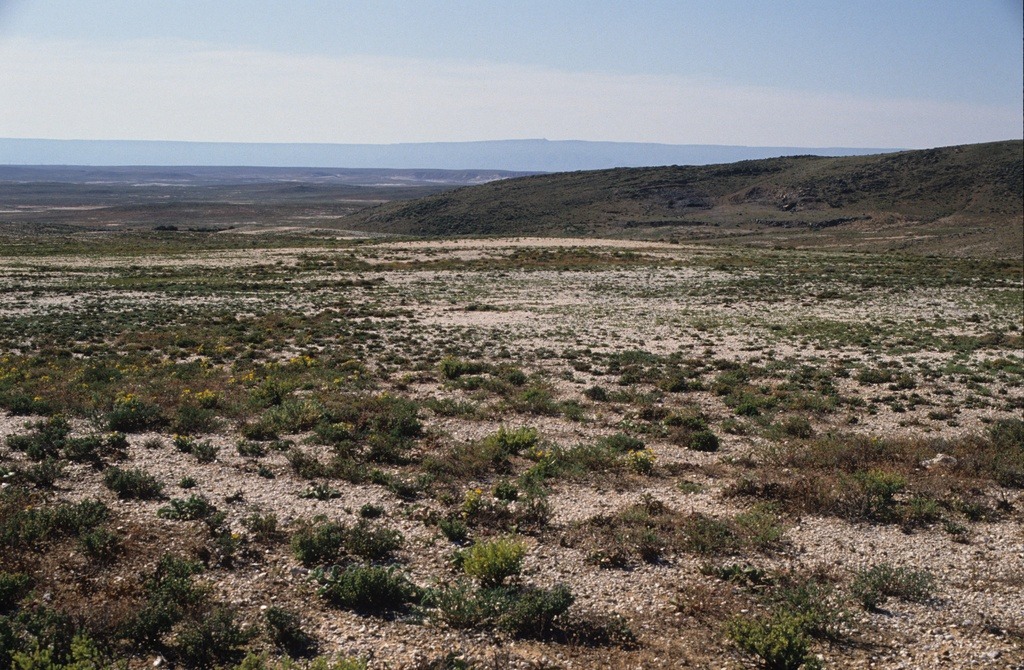
Kheprisian and Khnemudial are located in the Knersvlakte region, characterised by a mosaic of floristically and ecologically distinct quartz vygieveld communities and low succulent shrublands. It is recognised by BirdLife International (2025), as a Key Biodiversity Area (KBA) due to the significant proportion of threatened species (up to 56).
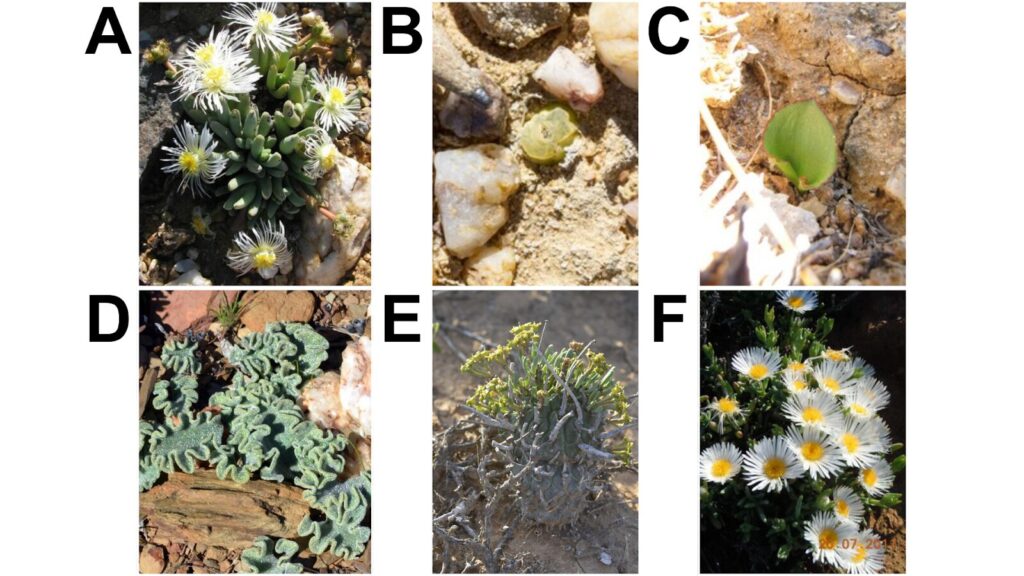
Many co-occurring, range-restricted flowering species are endemic to the Knersvlakte. These include the Asparagales, Asterales, Caryophyllales, Geraniales, Oxalidales, and Saxifragales taxonomic groups.
These small, low-growing plants are easily overlooked, such as the extremely rare Cephalophyllum staminodiosum, Conophytum acutum known as “knopies” in Afrikaans or buttons in English (CT), and Eriospermum calcareum (EN) to name a few (see image below for more).
“Without field survey data to establish the baseline floral communities, desktop studies are simply not enough to determine the impacts of prospecting activities that entail offroad driving and setting up drilling stations,” said Engelbrecht.
Woefully inadequate rehabilitation budgets
The National Environmental Management Act (NEMA) 107 of 1998 is South Africa’s foundational framework of environmental law. For every application, mining companies are required to provide an Annual Rehabilitation Plan; Final Rehabilitation, Decommissioning and Mine Closure Plan; and an Environmental Risk Assessment Report in terms of Regulation 11 (1) of GNR 1147, with financial provision for each.
Mobugen, Khnemudial, Kheprisian and Novari do not comply with this regulation, because they have not provided any of these plans. Rehabilitation activities must be itemised, planned, scheduled and budgeted in detail. This is to ensure that rehabilitation activities can be reviewed, audited, and shortcomings in the plan identified and the results tabulated annually.
PTWC experts posit that the financial provision for rehabilitation is woefully under-budgeted in each application, which fail to account for important costs such as the establishment and operation of plant nurseries, and maintenance and rehabilitation of existing farm and drill site access roads. These items can quickly increase rehabilitation costs from a few hundred thousand rands into the millions.
To ensure that these biodiverse and unique environments remain for generations to come and prevent unnecessary harm, responsible mining starts with sufficient planning and financial provision. There must be no shortcuts to rehabilitation.
“Mining companies are hungry for this stretch of coastline,” said PTWC MD Mike Schlebach. “Our main concern is the success of seemingly ill-prepared prospecting applications. Once prospecting rights are granted, the likelihood of a mining application being granted soon after is extremely high. With inadequate rehabilitation budgets and holes in the application documents, environmental detriment is inevitable. Help us fight this onslaught by adding your comments on Ripl. Every single voice counts.”
Register as an I&AP on Ripl: